Both trigger collagen renewal, but by different routes. Radiofrequency microneedling delivers energy through the tips of fine needles into the dermis, while fractional laser uses light to create micro-thermal zones spread across an area. The choice rests on scar type, skin type and the recovery time you can set aside.
What RF microneedling is and does
The treatment often called gold needling has a proper name: radiofrequency microneedling. Making that link at the outset clarifies every sentence that follows.
Gold plated micro needles open controlled micro channels in the skin while delivering radiofrequency energy from their tips. That produces both a mechanical stimulus and a controlled thermal effect in the dermis, with the aim of stimulating collagen and elastin production.
What distinguishes it is where the energy goes. Because the radiofrequency is delivered from the needle tips, the effect concentrates at the depth the needles reach rather than at the surface. Vivace is a well known device example of this technology.
The typical protocol is 3 to 4 sessions at roughly 4 to 6 week intervals. Because the result depends on collagen renewal it develops gradually; improvement begins to be noticed after the first or second session and builds across the course.

What fractional laser is and does
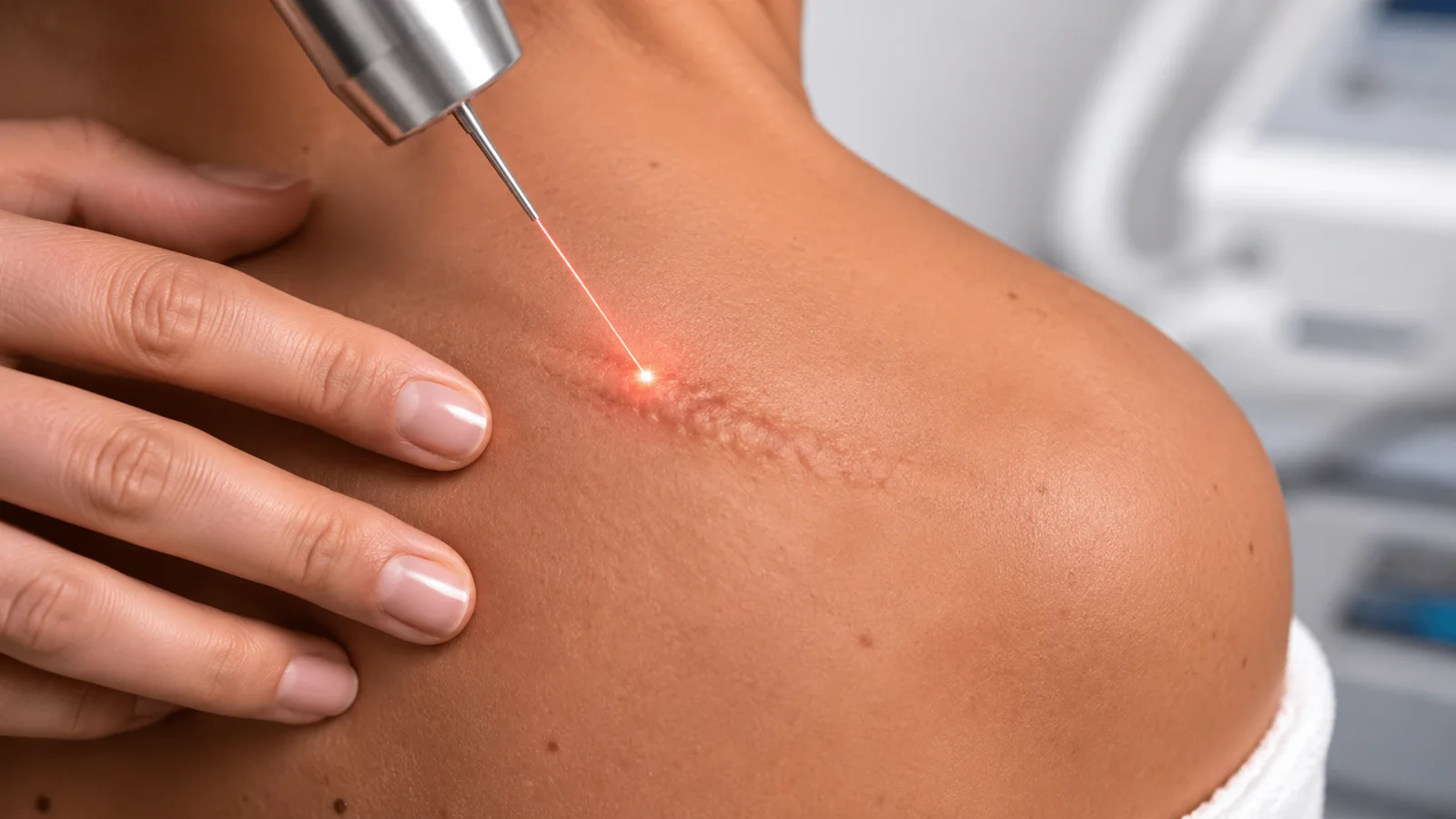
Fractional laser works on the principle its name points to: it targets micro areas distributed across a region rather than the region as a whole.
Untouched, intact tissue remains between those micro-thermal zones. Repair proceeds outward from that intact tissue, and collagen renewal is triggered in the process.
Fractional devices fall into two broad groups. Ablative systems remove tissue at the surface; non-ablative systems largely preserve the surface while acting in the layer beneath. That distinction sets the recovery time directly.
An honest boundary belongs here: for fractional laser, session count and interval vary markedly with the type of device, the settings used and the type of scar. Quoting a single range would mislead, and this information is given by a physician on a device and plan basis.
Energy route, surface effect and recovery, side by side
Reading five shared criteria separately for each side is the clearest way to run the comparison without turning it into an argument about superiority.
RF microneedling
- Energy route: micro needles open channels and radiofrequency is delivered from the tips; the effect concentrates in the dermis.
- Surface effect: pinpoint micro crusting can appear, while the surface is largely preserved.
- Sessions: the typical protocol is 3 to 4 sessions at roughly 4 to 6 week intervals.
- Recovery: redness, warmth and mild swelling in the first 24 to 72 hours; social return is usually 1 to 2 days and full settling can take a week.
- Skin type: a risk of temporary hyperpigmentation exists in darker skin types; sun protection afterwards is essential.
Fractional laser
- Energy route: light creates micro-thermal zones distributed across the area, with intact tissue left between them.
- Surface effect: ablative devices remove tissue at the surface; non-ablative devices largely preserve it.
- Sessions: varies with device type, settings and scar type; no single range can be given and the plan is built by a physician.
- Recovery: markedly longer with ablative options; a shorter process is described with non-ablative ones.
- Skin type: pigmentation risk is separately assessed in darker skin types, and sun protection is required.
The two are not rivals; in scar planning they are usually discussed at different stages of the same process. Combinations of methods are used in scar treatment, and which method enters at which stage follows the type of scar. For the treatment itself see our Vivace microneedling page, and for the general approach built around scar types see scar revision. Knowing from the start that the two are used in a planned sequence rather than in one session also sets the expectation correctly.
How scar type shapes the choice
This sits at the centre of the decision, because scar treatments are selected according to the type of scar.
Narrow and deep. Hard to address with a surface approach, so the plan usually calls for a combination.
Defined edges with a depressed base. Approaches aimed at tissue renewal are discussed in this group.
Giving the surface an undulating look. Stimulating collagen in the dermis is the heading that comes forward here.
Raised scars. Planning is especially careful in this group, and recurrence risk is assessed where there is a keloid tendency.
The practical value of this distinction is that it shows which layer the scar sits in. An irregularity close to the surface and a scar reaching deep into the dermis are not handled the same way; where energy cannot reach that layer, the result stays limited.
Skin type and the risk of pigmentation
This heading has to be raised for both methods and should never be skipped.
In radiofrequency microneedling there is a risk of temporary hyperpigmentation in darker skin types. It is a known matter, which is why sun protection after treatment is essential.
On the fractional laser side, pigmentation risk is likewise assessed separately in darker skin types, with device type and settings forming part of that assessment.
What follows is that no method carries the same safety profile across every skin type. The accurate sentence is that risk shifts with skin type and the plan is built accordingly.
The difference in recovery
In practice this is the heading that shapes the decision most: how much recovery time can be set aside.
With radiofrequency microneedling, redness, warmth and mild swelling are described in the first 24 to 72 hours. Pinpoint micro crusting can appear. Most people return to social life within 1 to 2 days, and the skin settling fully can take a week.
With fractional laser the process differs markedly by device type. Recovery is longer and more pronounced with ablative options, while a shorter process is described with non-ablative ones.
So the question of which heals faster has no single answer. The better question is which device, at which settings, and how many days the calendar allows.
Can both be used in the same plan?
Plans built on a single method are the minority in scar treatment; combination is a common approach.
The reason is that scar types coexist. Narrow deep scars and scars giving the surface an undulating look can sit side by side on the same face, and those two pictures do not respond to the same mechanism in the same way.
When a combination is built, the two are used in a planned sequence rather than in one session. Time is left between stages for the skin to settle, and the next step is decided once the result of the previous one can be seen.
What sets the order is the scar type and how the skin responds. A combination plan is therefore not drawn in full at the outset; it becomes clear as the first stage plays out.
When results become visible
What the two share is this: the result is gradual rather than immediate.
With radiofrequency microneedling, improvement begins to be noticed after the first or second session and builds with each one. Because the result depends on collagen renewal, it develops over weeks and months.
With fractional laser the mechanism also works through collagen renewal, so the result progresses in a similarly gradual way.
Assessment timing is therefore built the same way in both: a few weeks after a session for an interim look, with the final reading left to the months following completion of the course.
That shared quality matters for expectation. Judging the final result after a single session means reading the process halfway through, whichever method is used.
Why aftercare decides part of the result
In both methods, part of the outcome is decided in the period after the session.
In the first days the skin is repairing and more open to external factors. Keeping to simple, non-irritating products and not pushing the area are what is asked for.
Sun protection sits at the centre of this. In both methods it is inseparable from the process afterwards, and skipping it raises the risk of pigmentation.
Where aftercare is not followed, the most common consequence is not lasting damage but a postponed next session. Aftercare, in other words, is directly tied to keeping the plan on its calendar.
The realistic goal: how far a scar softens
Expert consensus is clear here, and this is the most honest sentence in the article.
The realistic goal is to reduce how prominent a scar looks. No method erases a scar completely; that is not a limitation of a device but a fact about how tissue repairs.
Saying so at the outset prevents most of the dissatisfaction that arises at the end of a process. Where a plan begins with the expectation that a scar will disappear, even a good result reads as a failure.
Session count and the combination of methods vary widely with scar type, so the plan is built on the scar types seen at examination rather than on a template.
There is another realistic boundary, and it is time. Scar treatments run over months and the result is read across the whole course rather than session by session. Knowing that calendar in advance prevents early judgements mid-process.
The same measure applies to skin tightening. The contribution of radiofrequency microneedling there is limited to a mild to moderate degree; it does not replace a surgical lift and is not presented as one.
Side effects and when treatment is not carried out
Both have known side effects and situations in which they are not performed.
With radiofrequency microneedling, temporary redness, swelling and mild flaking are expected. A risk of temporary hyperpigmentation exists in darker skin types, and sun protection afterwards is essential.
It is not carried out during pregnancy. Active skin infection or a cold sore, an active acne flare in the treatment area, and electronic implants such as a cardiac pacemaker are among the reasons treatment is not performed; because radiofrequency energy is used, the implant heading matters particularly here.
Where there is a tendency to keloid, the plan is built following medical assessment. Recent use of isotretinoin is likewise a heading calling for a medical decision.
A comparable assessment is made on the fractional laser side, weighing active infection, cold sores, skin type and scar type together. In both, suitability is established by examination.
How the decision becomes clear
The choice settles on three inputs: scar type, skin type and the recovery time available.
Scar type determines which mechanism comes forward. Skin type determines the pigmentation risk and therefore the range of settings. Available time determines whether an ablative approach is realistic at all.
When those three are weighed together at examination, the plan usually emerges as a sequence rather than a single method. Which one comes first is decided by the scar type and the state of the skin together.
Since 2019 the most common disappointment we have observed in the clinic belongs to people expecting a scar to disappear after a single session. In both methods the result depends on collagen renewal and arrives gradually. That is why a consultation begins by assessing the type and depth of the scar.
Frequently asked questions
RF microneedling or fractional laser, which should I choose?
Both trigger collagen renewal but by different routes: RF microneedling delivers energy from needle tips into the dermis, while fractional laser creates micro-thermal zones with light. Scar type, skin type and available recovery time decide.
What is gold needling?
It is a colloquial name; the correct medical term is radiofrequency microneedling. Gold plated micro needles open channels in the skin while delivering radiofrequency energy from their tips, stimulating collagen and elastin production in the dermis.
How many sessions does RF microneedling take?
The typical protocol is 3 to 4 sessions at roughly 4 to 6 week intervals. Because the result depends on collagen renewal it develops gradually, beginning to be noticed after the first or second session.
How long is the recovery?
With RF microneedling, redness, warmth and mild swelling appear in the first 24 to 72 hours; social return is usually 1 to 2 days and full settling can take a week. With fractional laser, the time varies markedly depending on whether the device is ablative.
Will acne scars disappear completely?
The realistic goal is to reduce how prominent the scar looks. No method erases a scar completely; that is expert consensus. Session count and the combination of methods vary widely with scar type.
Can these be used on darker skin?
Assessment is needed. RF microneedling carries a risk of temporary hyperpigmentation in darker skin types and sun protection is essential; with fractional laser, pigmentation risk is likewise assessed separately.
Does RF microneedling replace a surgical lift?
It does not. Its skin tightening contribution is limited to a mild to moderate degree and it is not presented as an alternative to surgery. The expectation is set within that frame.
When is RF microneedling not carried out?
It is not performed during pregnancy, in active skin infection or cold sore, during an active acne flare in the area, or where an electronic implant such as a cardiac pacemaker is present. Keloid tendency and recent isotretinoin use require medical assessment.
This content is provided for general information only and does not constitute medical advice. Gold needling is a colloquial name; the correct medical term is radiofrequency microneedling. The typical protocol is 3 to 4 sessions at roughly 4 to 6 week intervals, and the result develops gradually through collagen renewal. Redness, warmth and mild swelling can appear in the first 24 to 72 hours; pinpoint micro crusting is possible, social return is usually 1 to 2 days and the skin settling fully can take a week. A risk of temporary hyperpigmentation exists in darker skin types and sun protection afterwards is essential. Treatment is not carried out during pregnancy, in active skin infection or cold sore, during an active acne flare in the area, or where there is an electronic implant such as a cardiac pacemaker; a tendency to keloid and recent use of isotretinoin require medical assessment. With fractional laser, session count and recovery vary with device type, settings and scar type, and that information is given by a physician on a plan basis. In scar treatment the realistic goal is to reduce how prominent a scar looks; no method erases a scar completely. The skin tightening contribution of radiofrequency microneedling is limited to a mild to moderate degree and does not replace a surgical lift. Suitability is established only after specialist assessment.
Content overseen by Aysun Kaya, Founder · Kaya Clinique · on Bağdat Avenue since 2019. Our publishing standards are set out in our editorial principles.