Arm Lift
Smoother lines along the arm
Arm Lift is a treatment considered in line with the person's needs and expectations. At Kaya Clinique it is assessed with an understanding of comfort and balance in body proportions, and with individual planning.
Arrange a Specialist ConsultationAn arm lift is usually the last step in a longer process rather than a standalone decision: the skin left behind after significant weight loss. The sections below explain why that skin does not retract on its own, where non-surgical options stop, what the scar actually looks like and how the recovery is structured.
What is an arm lift and who is a candidate?
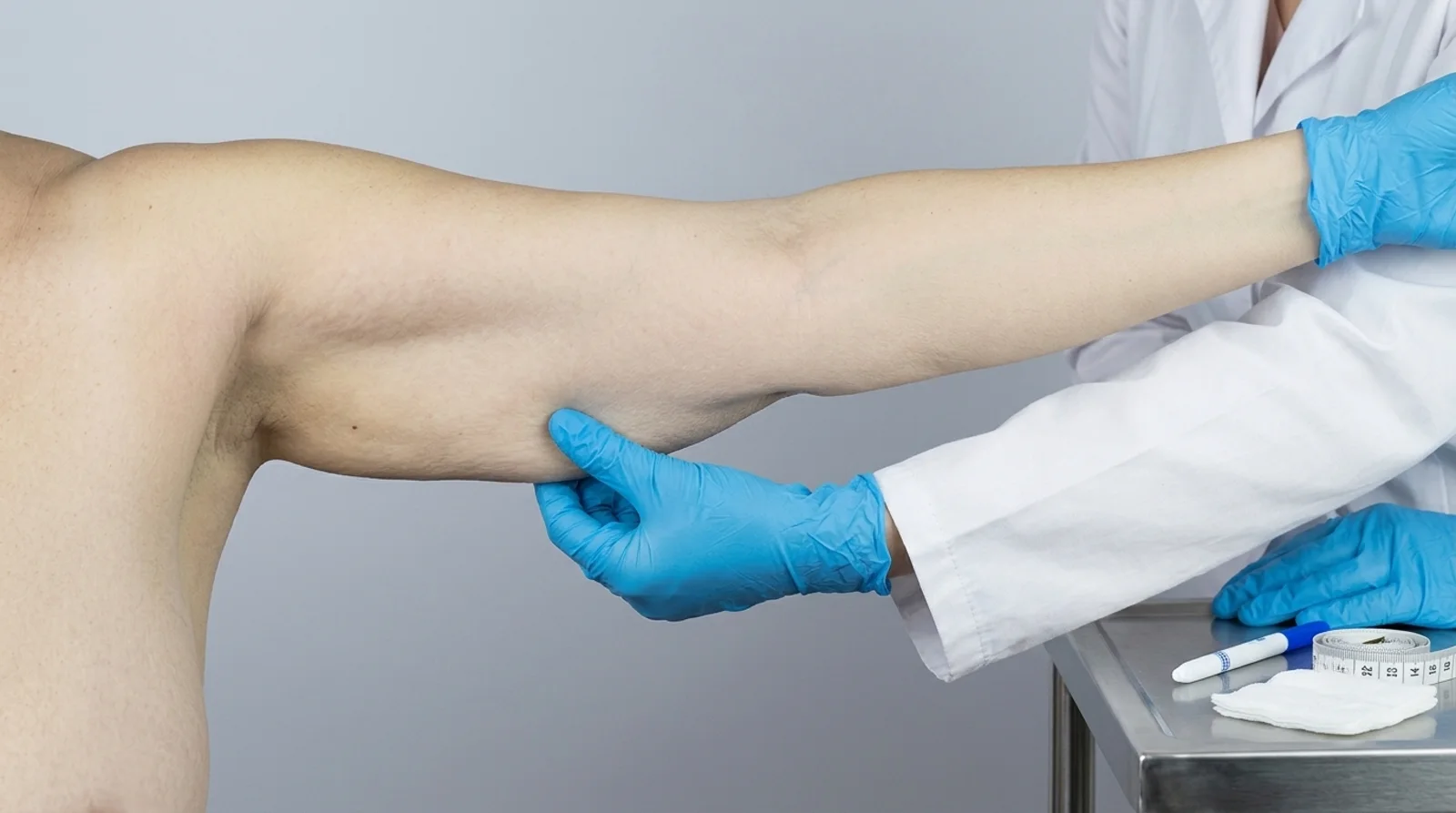
Also known as brachioplasty, an arm lift is surgery in which loose skin and fat tissue on the inner surface of the upper arm is removed. The purpose is not to reduce tissue for its own sake but to take in an envelope that has become too large for what it covers.
The most typical candidate is someone whose arms have changed after substantial weight loss. As fat is lost, the skin does not retract at the same pace, leaving tissue that hangs on the inner arm.
The same picture can appear with age, where reduced skin elasticity produces a similar result without any large change in weight.
What the assessment looks at is not the size of the arm but the amount of excess and the quality of the skin. How much loose skin there is, how much fat sits beneath it and how well the skin retracts are all evaluated together. Where weight is still changing, or where a significant weight target lies ahead, deferring surgery until after that process is discussed.
Why does arm skin loosen after weight loss?
Skin is an elastic covering that adapts to the volume beneath it, but that adaptation has limits.
Where skin has been stretched for a long period, its elastic fibre structure is placed under strain, and when the underlying volume reduces the return is not as complete as expected. What remains is an envelope larger than the tissue it now covers.
How pronounced this becomes depends on several things: how quickly the weight was gained and lost, how much was lost, age, and the individual characteristics of the skin. Two people losing the same amount of weight do not end up in the same place, because the capacity of skin to retract is individual.
The arms are also rarely alone. A similar picture often appears at the abdomen after significant weight loss, which is why the assessment is not limited to one area and abdominoplasty may be discussed in the same consultation. Which area is addressed first, and whether the procedures are planned separately, is decided after examination.
Can loose arm skin be tightened without surgery?
The answer depends on what is actually producing the appearance, and two situations need separating.
Where the complaint comes mainly from fat volume and the skin still retracts well, non-surgical options can be discussed. Treatments combining resistive radiofrequency with deep rotational massage, such as Zionic, sit in this group; they work on skin quality and the appearance of contour.
Where there is a genuine excess of skin, the position changes entirely. No non-surgical treatment removes surplus skin, because removing tissue is not how any of them work. Where an envelope is hanging, shortening it requires surgery.
A third situation exists as well: in some people excess fat and excess skin are present together. A non-surgical treatment may contribute to part of the appearance there while leaving the hanging envelope untouched, and which part of the expectation can be met by which approach is discussed from the outset.
The right question is not which method is better. It is whether what is hanging is skin or fat, because the answer decides the method for you.
Arm lift or liposuction?
These are compared frequently because both are described as making the arm look slimmer. The layer each addresses is different, and that difference decides the outcome.
- An envelope hangs on the inner surface of the arm.
- The skin has been stretched beyond its capacity to retract.
- Removing fat alone does not change the appearance.
- An arm lift is the procedure discussed.
- Skin tone is preserved and nothing hangs.
- The complaint is localised volume.
- There is no need to remove excess skin.
- Options aimed at the fat layer are weighed up instead.
What does the arm lift scar look like?
This is the most discussed aspect of the operation and the honest answer is that the scar is permanent. Skin is removed, so an incision is unavoidable, and it leaves a line running along the inner surface of the arm. How that scar matures over the following months is set out under scar revision. Because the inner arm carries hair, the timing of laser hair removal is also discussed alongside the dressing period.
Its length depends on how much skin is removed. Where the excess is limited to an area near the armpit the line can be shorter; where it extends along the arm, so does the incision. For that reason where the incision will begin and end is explained individually before surgery.
The expectation is set as follows: the scar is more noticeable in the early months, fades over time and takes a long period to mature. It settles as a fine, pale line and remains present. Because of its position it is not obvious in most postures, though it can be visible when the arm is raised.
Sun protection, the care routine described by the surgeon and the individual's own healing all influence how the scar behaves. Anyone with a history of keloid or hypertrophic scarring is assessed separately on this point, and the question is always asked at the consultation.
What is the recovery timeline after an arm lift?
Recovery here directly affects the use of the arms, which makes it more disruptive to daily routine than the operation itself suggests.
First days
Swelling, tightness and difficulty moving the arm are expected. Compression garment use begins in this period.
1 to 2 weeks
Returning to a daily routine that does not strain the arms is discussed within this range. Where there is no true skin excess and the concern is localised fat, surgery does not arise; the heading discussed instead is cryolipolysis, which does not replace an arm lift.
4 to 6 weeks
Return to full activity is assessed here, with weight training left until last.
Following months
As swelling resolves the contour becomes clearer, while scar maturation continues.
How long is the compression garment worn?
Its purpose is to control swelling and to support the tissue as it settles into its new position. The duration varies with the individual and with how healing progresses, so no fixed number of days is quoted here; the surgeon sets it according to the findings at follow-up appointments.
When can the arms take load again?
Movements that raise the arms overhead or place tension across the suture line are restricted early on. The restriction relates to the tension on that line rather than to comfort, and which movements resume when is opened up in stages based on examination findings.
How long does the result last?
The skin removed does not come back, so the change achieved is long lasting. The arm nonetheless remains part of a body that continues to change.
Significant weight change after surgery affects the appearance directly.
The natural reduction in elasticity with age continues regardless of surgery.
Broader changes in body composition are reflected in the arms as well.
Operating once weight has stabilised supports a more durable result. The same process affects other regions: buttock aesthetics and leg and calf implants are assessed on their own criteria, while breast lift is discussed as a separate heading within the same consultation.
For those reasons no undertaking is given that looseness will never occur again. What is offered is the removal of the current excess and a change that lasts, with the timing of surgery treated as part of that conversation rather than an administrative detail.
What are the risks of an arm lift?
Brachioplasty is a surgical procedure carried out under general anaesthesia. Bleeding, infection and anaesthesia-related considerations apply here as in any operation.
The items specific to this procedure are delayed healing along the suture line on the inner arm, changes in sensation along that line, asymmetry between the two arms, swelling lasting longer than expected and a scar maturing more prominently than anticipated. Because lymphatic and nerve structures lie close to this area, surgical planning is carried out with their preservation in mind.
Smoking has a particular place in this operation, since it reduces the blood reaching tissue and makes wound healing along a long incision more difficult; stopping around the time of surgery is requested for that reason.
Preoperative assessment reviews general health, regularly used medications and previous procedures. Where the physician considers investigations necessary, their results can influence the plan directly, and information withheld at this stage works against a safe operation.
At the decision stage the subject is largely the scar. Whether the person knows where it will sit, how long it may be and that it is permanent is established before a plan is made, alongside how the appearance of the arm affects them day to day.
The process concludes with written informed consent recording the position of the incision, the permanent nature of the scar, the recovery timeline, the order in which activity resumes and the known risks. The operation itself is planned and carried out by the physician responsible, in a facility equipped to the standards the procedure requires; our involvement covers assessment, information and the appointments that follow.
This content is provided for general information only and does not constitute medical advice. An arm lift is a surgical procedure and carries risks including bleeding, infection, anaesthesia-related risks, delayed healing along the suture line, changes in sensation, asymmetry and prolonged swelling. The scar from this operation is permanent; it runs along the inner surface of the arm, fades over time and does not disappear, and its length depends on the amount of skin removed. Recovery broadly involves returning to daily life at one to two weeks and to full activity at four to six weeks, with the individual timeline set by the surgeon. The change achieved is long lasting, but weight change and ageing can affect the appearance again; no undertaking is given that looseness will not occur again. Non-surgical treatments do not remove excess skin. The decision to operate is made together with the physician after a detailed examination and a written informed consent process.
Content overseen by Aysun Kaya, Founder · Kaya Clinique · on Bağdat Avenue since 2019. Our publishing standards are set out in our editorial principles.
From consultation to care, the process

Beklentilerinizi dinleyerek, kişiye özel bir yol haritası oluşturuyoruz.

Modern, hijyenik ve mahremiyeti önceleyen bir klinik ortamı.

Konforunuz gözetilerek, ölçülü ve kontrollü bir yaklaşım.

Süreç sonrası bilgilendirme ve takip ile yanınızdayız.
Related technology

Cryolipolysis
Cryolipolysis is a treatment considered in line with the person's needs and expectations. At Kaya Clinique it is assessed with an understanding of…
Explore the Technology →
Laser Hair Removal
Laser Hair Removal is a treatment considered in line with the person's needs and expectations. At Kaya Clinique it is assessed with an understanding of…
Explore the Technology →Frequently asked questions
How are Arm Lift prices determined in 2026?
Our pages carry no figure for Arm Lift prices, and that is a legal limit rather than an oversight: healthcare institutions may not announce procedure fees.
Although no figure is given, we can say plainly what varies in Arm Lift. The determining items are:
- The amount of skin removed and the incision length that follows
- Whether fat tissue is also addressed
- The length of the operation and the anaesthesia choice
- Reviews planned through the compression garment period
The weight of each item differs in every person, so no common amount can be quoted for Arm Lift. How the process will unfold is set out in detail after examination.
Treatments considered alongside this one
Whether they can be planned together is decided at examination; this is not a recommendation list.