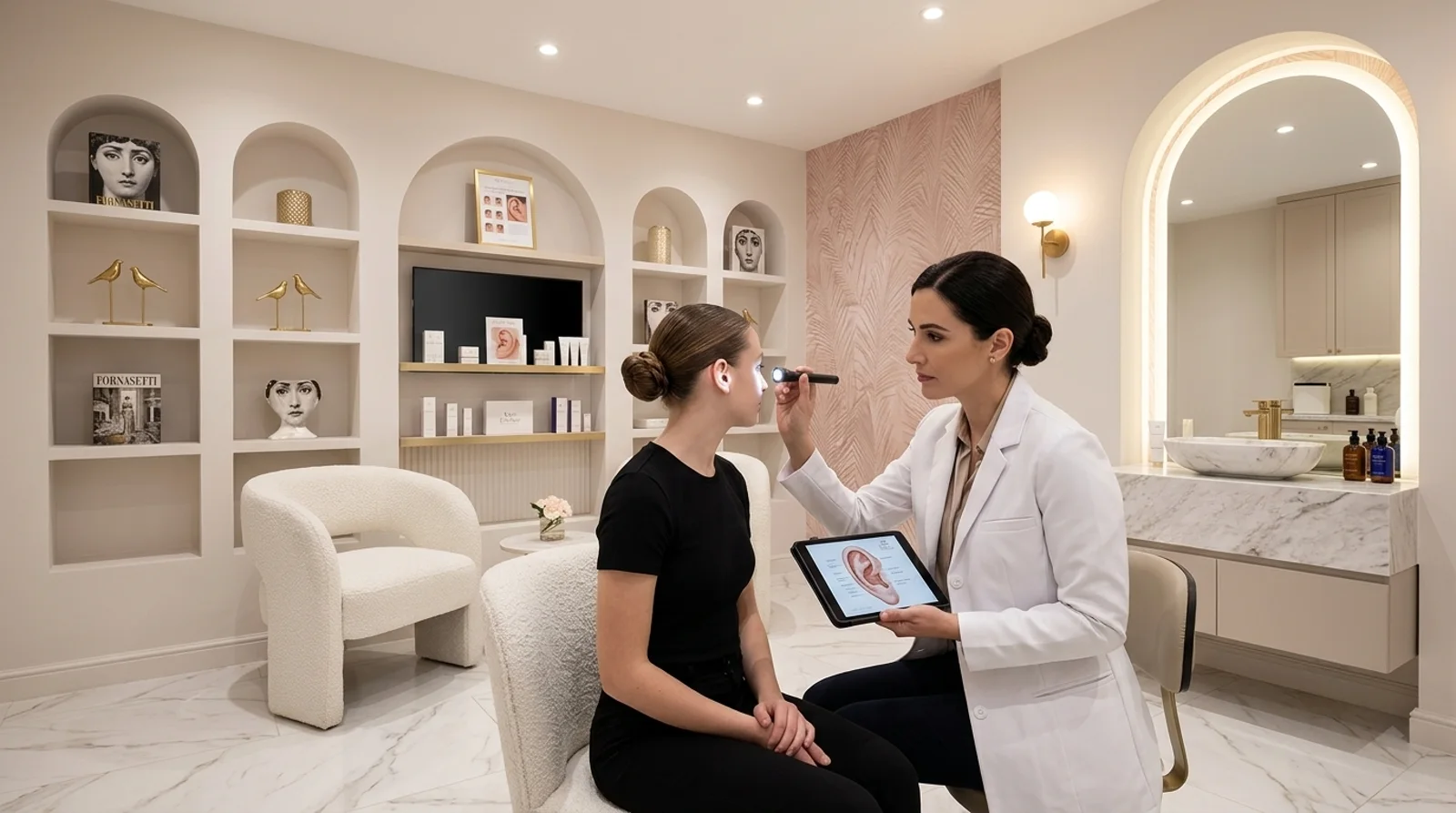
Otoplasty
A proportionate ear appearance
Otoplasty is a treatment considered in line with the person's needs and expectations. At Kaya Clinique it is assessed with an understanding of balance and natural expression in the facial features, and with individual planning.
Arrange a Specialist ConsultationOtoplasty is one of the few aesthetic operations frequently considered for children as well as adults, which makes the questions around it different from most. Alongside the usual ones about recovery and scarring sits a more delicate one about who is asking for the operation. This page covers both.
What does otoplasty involve?
Otoplasty is surgery in which the cartilage of the ear is reshaped. The aim is to change how the ear sits relative to the head, and the work is done on the cartilage framework rather than on the skin alone.
This is why it is a structural operation rather than a superficial one. The shape being addressed is built into the cartilage, and altering it requires working directly with that structure. It is also why the timing differs from other facial procedures: rhinoplasty and eyelid aesthetics wait for facial growth to complete, whereas cartilage in the ear reaches that threshold earlier.
Both ears are usually assessed even where only one is the source of the complaint, since the two are read against each other. What is planned is a relationship between them rather than a measurement on one side.
At what age can otoplasty be performed?
The requirement is that ear development has been completed, which is generally the case from school age onwards.
That is deliberately stated as a stage rather than a specific age, because development does not complete on the same schedule in every child. What is assessed at examination is whether the ear has reached its adult form, not what a birthday certificate says.
There is no upper age limit. Adults request this operation as often as it is requested for children, and the surgical considerations are the same; what differs is the consent process, which is covered below.
What is the recovery timeline after otoplasty?
Recovery here is more about protection than about discomfort, and the timeline is straightforward.
First week
A dressing or protective band is worn during this period to support the new position.
Around 1 week
Most people return to daily life within this period, depending on how healing is progressing.
2 to 3 weeks
Visible healing progresses noticeably across this period.
4 to 8 weeks
Tissue healing approaches completion within this range.
The use of a band at night after the initial period is common practice, but the duration varies from surgeon to surgeon. There is no universal figure for it, and the instruction that applies is the one given by the operating surgeon.
The operation reshapes cartilage in an afternoon. Protecting that new shape while it settles is the part that takes weeks, and it is the part people underestimate.
When can sport be resumed?
General activity resumes early, but contact sport is a separate question with a longer answer.
Avoiding contact sports for approximately three months is advised. The reason is direct: an impact to the ear during the healing period can affect the result that has just been created.
For children this needs planning rather than improvising, since school sport is not always easy to opt out of at short notice. Discussing the timing before the operation, and choosing a period that fits around the sporting calendar, makes the restriction far easier to observe.
Where is the incision and will there be a scar?
The incision is placed behind the ear, in the fold where the ear meets the head.
Because of that placement it is not visible in ordinary view, which is the main reason this operation is often described as leaving no visible mark. That description is close but not precise: there is a scar, and it sits where it is not readily seen.
The honest account of how it behaves is the same as for any scar. It fades over time and it does not disappear entirely. Anyone with a history of keloid or hypertrophic scarring should say so at the consultation, since that changes how healing is expected to progress.
Can the ears return to their previous shape?
This is worth addressing directly rather than leaving in the risk list, because it is the question people ask after the operation rather than before it.
Cartilage has a tendency to return towards its original shape, and recurrence is a recognised, if uncommon, outcome of this operation. It is one of the reasons the protective band is used and one of the reasons the early period matters.
It follows that no guarantee of lasting symmetry can be given. A degree of difference between the two ears is normal in everyone before surgery and remains possible afterwards; what is aimed at is a natural relationship between them rather than an identical pair.
It also follows that a further procedure cannot be ruled out in advance. Saying that a single operation will settle the matter with no possibility of revision would not be accurate, and it is not something this page claims.
When the patient is a child
Where the person having the operation is a child, an additional layer applies to the decision, and it is not a formality.
Consent is given by the parent or guardian, but the child's own view is part of the conversation. A child who does not want the operation is in a different position from one who has raised the subject themselves, and that difference is taken seriously at assessment.
What this page does not do is attach social outcomes to the procedure. Claims about what an operation will change in a child's school life or relationships are not something surgery can promise, and framing the decision that way puts weight on it that it cannot carry.
Whether ear development has completed is established at examination. Ear position forms one component of facial proportion, so where the expectation is broader the assessment widens into facial aesthetics; findings in the upper face are assessed under temple lift and brow lift and in the mid-face under mid-face lift. How the scar behind the ear matures is set out under scar revision, and where the concern is the quality of the skin rather than shape, skin booster sits on a separate axis.
What the child thinks about the operation is part of the assessment.
Consent is given by the parent or guardian through a documented process.
School and sporting commitments influence when the operation is planned.
What are the risks and how is the decision made?
Otoplasty is surgery and the risk assessment is made on that basis.
The recognised considerations are infection, haematoma, numbness in the area, scarring, asymmetry between the two sides and recurrence, meaning the tendency of the cartilage to return towards its previous shape. Bleeding and anaesthesia-related risks apply as in any operation.
- Where the incision will sit and how the scar behaves.
- The protective period and what it restricts.
- The possibility of recurrence and of a further procedure.
- That identical symmetry is not the goal.
- General health and any regular medications.
- Previous surgery or injury to the ear.
- Any history of keloid or hypertrophic scarring.
- Whether ear development has completed.
What should prompt contact after surgery?
Increasing pain, swelling that worsens rather than settling, a change in the colour of the skin over the ear, discharge or fever should be reported without waiting for the scheduled appointment. Haematoma in particular is a finding that benefits from being assessed early rather than observed at home.
This content is provided for general information only and does not constitute medical advice. Otoplasty is surgery in which the cartilage of the ear is reshaped, and it can be carried out once ear development has been completed, generally from school age onwards. It carries risks including infection, haematoma, numbness, scarring, asymmetry between the two sides and recurrence, meaning the tendency of the cartilage to return towards its previous shape; these are uncommon but recognised. Bleeding and anaesthesia-related risks apply as in any operation. A dressing or protective band is worn during the first week; most people return to daily life within about a week, visible healing progresses over two to three weeks and tissue healing approaches completion at four to eight weeks. Avoiding contact sports for approximately three months is advised. The duration of night-time band use varies between surgeons and the instruction given by the operating surgeon applies. The incision is placed behind the ear; the scar fades over time but does not disappear entirely. No guarantee of lasting symmetry is given and a further procedure cannot be ruled out in advance. Where the patient is a child, consent is given by the parent or guardian and the child's own view forms part of the assessment. The decision to operate is made together with the physician after a detailed examination and a written informed consent process.
Content overseen by Aysun Kaya, Founder · Kaya Clinique · on Bağdat Avenue since 2019. Our publishing standards are set out in our editorial principles.
From consultation to care, the process

Beklentilerinizi dinleyerek, kişiye özel bir yol haritası oluşturuyoruz.

Modern, hijyenik ve mahremiyeti önceleyen bir klinik ortamı.

Konforunuz gözetilerek, ölçülü ve kontrollü bir yaklaşım.

Süreç sonrası bilgilendirme ve takip ile yanınızdayız.
Frequently asked questions
How are Otoplasty prices determined in 2026?
To be clear about Otoplasty prices: we do not publish a number, because regulation prohibits healthcare institutions from announcing fees or campaigns.
What can be shared is how the plan for Otoplasty is formed. The decisive headings are:
- Whether one ear or both are addressed
- The state of the cartilage and how extensive the chosen technique is
- The anaesthesia choice tied to age
- The number of reviews planned through the dressing period
Otoplasty corresponds to different plans in two people, which is why one number would mislead. Assessment is made at examination and the plan shared in consultation.
Treatments considered alongside this one

Whether they can be planned together is decided at examination; this is not a recommendation list.